
Pick up a well-made wooden chair and turn it over. The first thing you notice is not the finish or the shape. It is the quiet confidence of the joints: tight, square, a little bit hidden, doing all the work without drawing attention to themselves. That kind of quality is rarely an accident of the final hour. It comes from decisions made earlier, about which board goes where, which way the grain runs and how two pieces will hold together for thirty years. The craftspeople at Best Carpenters Group will tell you that most of carpentry happens in the thinking, and this piece looks at three of the decisions that matter most.
Wood Is Not Finished Growing
The most important thing to understand about lumber is that it stays alive in a sense. Long after the tree is cut and the board is milled, wood keeps taking on and releasing moisture from the surrounding air. As it does, it swells and shrinks, mostly across the width of the board and very little along its length. A tabletop that fit snugly in a damp August can open gaps in a dry January.
Good carpenters design around this instead of fighting it. A solid wood tabletop is attached with fasteners or clips that let it slide a little as it moves. A frame-and-panel door holds its center panel loosely in a groove so the panel can expand without splitting the frame. Trim is nailed in a way that allows seasonal movement. When you see a crack in a piece of furniture or a gap opening in a floor, the cause is usually a design that forgot the wood would move.
Moisture content at the time of building matters as well. Lumber that is not properly dried, or that has not had time to settle into the conditions of the room where it will live, keeps changing after installation. Experienced builders let material acclimate before cutting it, and they pay attention to where it was stored.
Reading the Grain
Every board carries a map of how the tree grew, and a carpenter reads it before choosing how to use it. Straight, even grain tends to be stable and predictable, while wild or swirling grain can be beautiful but may twist or tear when planed. The way a board was cut from the log affects how it behaves too. Boards sawn so the growth rings run nearly vertical through the thickness, usually called quartersawn, tend to be more stable across their width and show a distinctive straight pattern. Boards cut with rings running more flat, called plainsawn, show the familiar cathedral figure and are more prone to cupping.
Grain direction also decides how strong a part will be. A chair leg cut with the grain running along its length stands up to load far better than one where the grain runs out the side, which can snap at the weak point. The same logic applies to shelves, stair parts and anything that carries weight. Matching grain on adjacent boards, so color and pattern flow across a panel or cabinet face, is a matter of appearance, but it also reflects a carpenter who looked at the pile and chose carefully instead of grabbing the nearest board.
Choosing the Joint
Joinery is where this thinking becomes visible. A joint’s job is to resist the particular forces that will act on it, and different joints do that job differently.
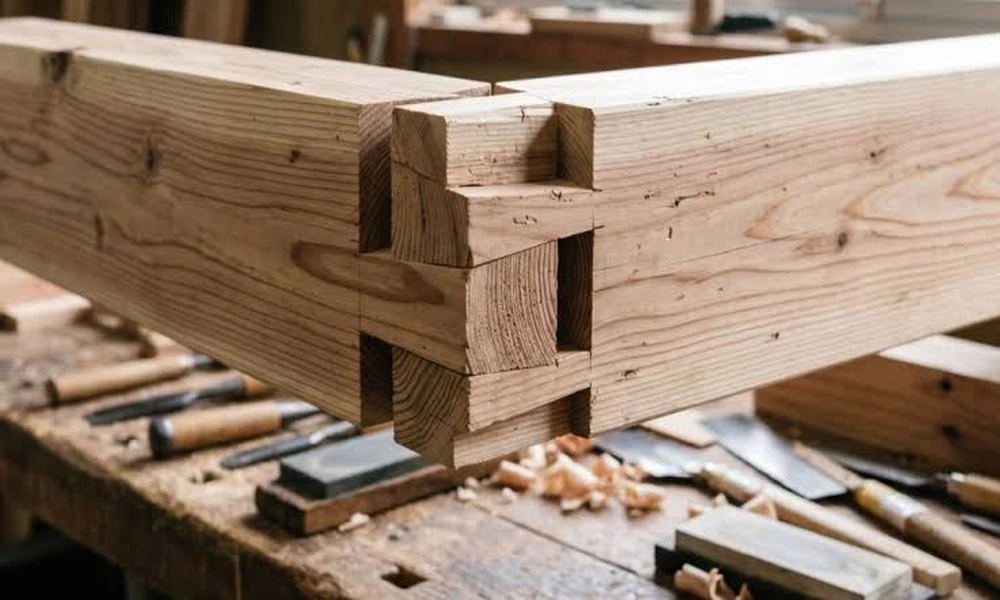
A butt joint, where two boards simply meet, depends almost entirely on glue or fasteners and is the weakest option on its own. A lap joint increases glue area and resists twisting. A mortise and tenon, in which a projecting tongue fits a matching socket, has been the backbone of framing, doors and furniture for centuries because it resists racking and pulls tight under load. Dovetails lock drawer sides together so the joint resists being pulled apart, which is why they appear in drawers that need to survive daily yanking. Dowels, biscuits and pocket screws offer speed and alignment, and in the right places they are perfectly sound, though they suit some applications better than others.
None of these is better in every case. A carpenter picks a joint by asking what will pull on it, what will push on it and whether it must be hidden, adjustable or repairable later. Strong joinery can look plain, and fancy joinery can be unnecessary. The skill lies in matching one to the other.
The Truth About Glue and Fasteners
Modern wood glue is remarkably strong, often stronger than the wood around it, but only when the joint is well fitted. Glue fills very small gaps poorly, so a sloppy joint relies on the adhesive to do work it was never meant to do. Clean, tight surfaces, proper clamping pressure and enough open time to assemble before the glue skins over are the unglamorous ingredients of a lasting bond.
Fasteners deserve the same care. Screws hold better than nails in many situations and can be removed, but they need pilot holes in hardwood to avoid splitting. Exterior work calls for corrosion-resistant hardware, since ordinary steel will stain and weaken, particularly in treated lumber. The U.S. Forest Service’s Forest Products Laboratory is a respected source of research on how wood behaves, and its Wood Handbook is a detailed reference on moisture, strength and the properties of different species for anyone who wants to go deeper.
What This Means If You Are Hiring
You do not need to know a mortise from a dado to hire well, but a few observations help. Ask how the carpenter handles wood movement in the piece or room you are planning. Ask what species and grade they recommend and why, and how the material will be dried and stored before work. For trim, cabinetry and built-ins, look at the inside of finished work, the backs and undersides and the corners, since that is where corners cut tend to show. Good carpenters are usually pleased to be asked, because the answers are the part of the job they find interesting.
It is also reasonable to ask what the work will look like in five or ten years, not just on the day it is finished. A craftsperson who talks about seasons, grain and joinery is thinking in that time frame already.
The Quiet Part
Most of what separates excellent carpentry from the merely adequate is invisible once the job is done. Nobody sees the board that was rejected for its grain, the joint cut a little tighter than necessary or the panel left room to breathe. But those choices are the reason a cabinet door still closes cleanly after a decade and a staircase stays silent underfoot. Look for the people who care about the parts you will never see, and the parts you do see will take care of themselves.

Comments are closed.