
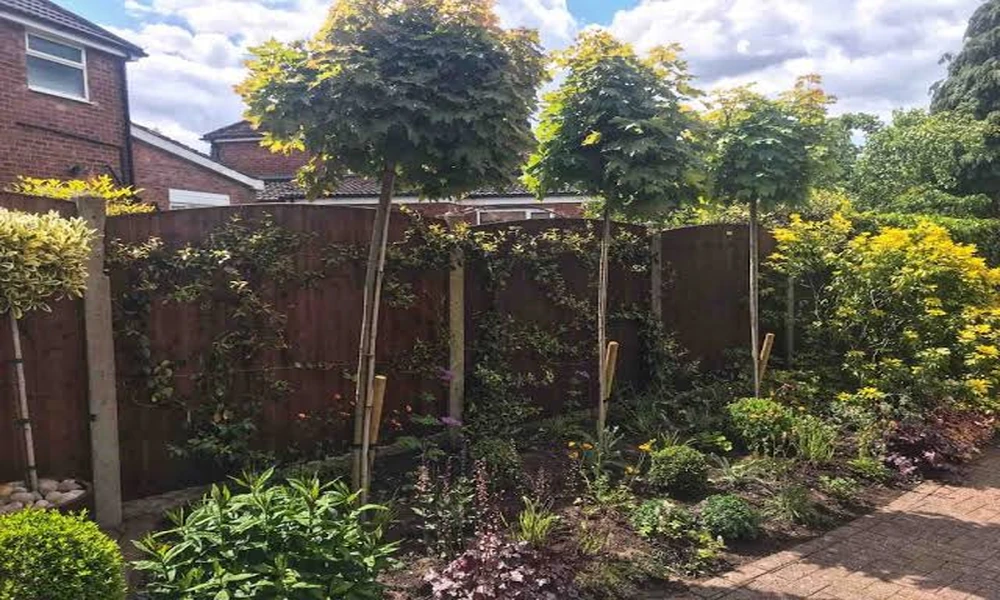
Autumn is the time of year when I start looking at fences differently. A fence that has sat quietly through summer can suddenly spend three months being pushed, pulled and rattled by wind from every direction. After decades installing and repairing garden fencing, I have learned that the strongest-looking fence is not always the one that copes best with exposed conditions. Sometimes letting the wind through is far more effective than trying to fight it.
That matters around York.
We have plenty of sheltered urban gardens, but move towards more open parts of the city and surrounding villages and conditions can change quickly. Long rear boundaries, corner plots and gardens backing onto open land can take a real battering once autumn weather arrives.
Every year, the same pattern starts.
The first proper windy spell arrives. Panels begin rattling. Posts that seemed solid in August start moving. Gates stop closing properly. Then one particularly rough night finishes the job.
The storm gets blamed.
Quite often, though, the design of the fence was working against it from day one.
A solid fence is basically a sail
This is the easiest way to understand wind damage.
Take a standard six-foot solid fence panel and put it across an exposed garden. There is nowhere for the wind to go. The whole surface catches it.
That pressure transfers into the rails, posts and concrete foundations.
Now multiply that across ten panels.
You have a considerable surface area fighting against the wind.
I have been to plenty of fence repair jobs where the panels themselves were still perfectly usable. The failure happened underneath because repeated wind loading worked the posts loose.
That is why simply buying thicker panels does not always solve an exposed garden.
Sometimes the design needs changing.
Hit and miss fencing deserves more attention
For windy gardens, hit and miss fencing is one of the first options I consider.
The boards alternate between each side of the rails, leaving controlled gaps for air to pass through. You still get a strong boundary and useful privacy, but the fence does not take the full force of every gust.
It also looks good from both sides.
That can be useful on shared boundaries where neither neighbour particularly wants to stare at the back of somebody else’s fence.
There is a trade-off. Hit and miss fencing uses more timber than a basic panel system and takes longer to construct properly. That usually means a higher initial fence installation cost.
In an exposed garden, I would rather spend money on a design suited to the conditions than keep replacing cheap panels.
I have seen homeowners do the latter three times.
It stops being cheap surprisingly quickly.
Slatted fencing can work well – with one warning
Contemporary slatted fencing has become very popular.
It suits modern extensions, rendered houses, garden rooms and landscaped gardens. Horizontal timber battens create clean lines while the gaps allow some air through.
From a wind point of view, that can be useful.
But spacing matters.
I have seen so-called slatted fencing where the boards are installed almost flush against each other. At that point, you have effectively built a solid wall from lots of small pieces of timber.
It looks slatted. It does not behave like slatted fencing.
Leave sensible gaps and wind pressure reduces.
Go too far the other way and privacy disappears.
A decent fencing contractor has to balance both.
The battens also need enough support. Long horizontal timber will move, particularly as moisture levels change through autumn and winter. Poorly supported battens twist and bow.
The design is simple. Getting it right takes a little more thought.
Traditional closeboard remains difficult to beat
I have installed enough closeboard fencing over the years to have a lot of respect for it.
There is nothing fashionable about it.
That is partly why it works.
Individual feather edge boards are fixed onto horizontal rails supported by solid posts. If one board becomes damaged, you can replace it without removing an entire panel.
Properly constructed closeboard fencing is strong.
For exposed gardens, though, the same basic rule still applies. It is a largely solid surface, so posts and foundations need to cope with the wind load.
This is where some fencing contractors near me searches lead homeowners down the wrong path.
They are told closeboard is stronger, so they assume it cannot fail.
It absolutely can.
Put strong fencing onto weak posts and you have simply built a better sail.
Panel fencing still has a place
I sometimes hear people dismiss standard panel fencing completely.
I would not.
Good quality panels installed correctly can last very well in the right garden. They are quick to replace, widely available and usually cheaper than bespoke fencing.
For sheltered gardens in York, they often make perfect sense.
The mistake is using the same specification everywhere.
A protected garden between rows of houses does not need the same fence as a boundary backing onto open fields.
This is something fencing companies near me should be assessing before recommending materials.
There is no universal best fence.
There is only the fence that suits the job.
Look at where the wind actually comes from
This sounds obvious, but people often get it wrong.
Wind does not always travel neatly across a garden.
Buildings change it.
A narrow passage between two houses can accelerate air. Extensions create turbulence. Garages deflect gusts. A gap between buildings can concentrate wind directly onto one small section of fencing.
I have visited properties where nine panels were fine and the tenth failed repeatedly.
The homeowner kept replacing that panel.
Nobody stopped to ask why that exact panel kept breaking.
Stand in the garden on a windy day and the answer can become obvious.
You can sometimes hear it before you see it.
One section rattles harder. A corner post moves. A gate shakes against its latch.
Those clues matter.
York’s outer neighbourhoods can be very different
Local ground and exposure can change within a few miles.
A sheltered rear garden in Bootham or Holgate may experience relatively little direct wind. Properties around more open parts of Dunnington, Elvington, Wheldrake, Strensall or Stockton-on-the-Forest can have very different exposure depending on their position.
I would never specify fencing purely from a postcode.
The individual plot matters far more.
Gardens backing onto fields deserve particular attention. There is often nothing behind the boundary to break the wind before it reaches the fence.
New housing can create similar problems.
A new estate may look fairly protected once completed, but plots on outer boundaries can remain exposed for years while trees and planting establish.
If you are searching for a fence company near me, this is the sort of conversation worth having before anybody starts digging.
The post is still doing most of the work
We can talk about clever fence designs all day, but none of them excuse weak posts.
For a typical six-foot domestic fence, I normally expect substantial post depth, often around 600mm as a starting point. Ground conditions, fence height and exposure can mean going deeper.
Heavy clay brings its own problems around York.
Wet clay holds water and moves. A post that feels solid during a dry spell can behave very differently after weeks of autumn rain.
The hole needs to be right.
The concrete needs to be right.
The post needs to be right.
Then the fence above has a fighting chance.
Shallow posts are one of the main reasons fence repairs become necessary after storms.
Concrete posts can help, but they are not magic
Concrete posts remain popular for good reason.
They do not rot like timber. They are heavy. They work well with concrete gravel boards and removable panels.
For people wanting low-maintenance fencing, they are worth considering.
But concrete posts still rely on the ground supporting them.
I have pulled leaning concrete posts out of gardens with enormous lumps of concrete attached to the bottom.
The footing had not broken.
The ground around it had moved.
That is an important distinction.
Adding more concrete is not always the answer. Soil condition and drainage matter too.
In very wet gardens, water management around the fence line deserves consideration before installing anything heavy.
Timber posts need protection at the vulnerable point
Timber posts usually fail around ground level.
That is where oxygen, moisture and soil meet.
Below ground, timber may still look surprisingly healthy. Above ground, it can look perfect. Then you push the post and discover the middle has turned soft.
Pressure-treated timber helps enormously, but no treatment makes wood immortal.
Keeping soil and organic material away from the post helps.
So does proper drainage.
One thing I see constantly is soil piled against posts after landscaping work. Sometimes raised beds are built directly against them.
That holds moisture exactly where you do not want it.
If the garden is exposed as well, the combination of weakened timber and repeated wind movement eventually finishes the post.
Gravel boards do more than improve appearance
I am a fan of gravel boards for practical reasons.
They keep the main fencing away from wet soil.
That alone can add useful life to timber panels.
Concrete gravel boards are particularly useful where ground stays damp, though they add weight and need proper support.
Timber gravel boards give a softer appearance and are easier to replace.
Either is better than allowing expensive fence panels to sit permanently against wet ground.
During autumn, leaves can also build up against the bottom of fencing. Clear them occasionally.
It takes five minutes.
Leaving a wet pile of leaves pressed against timber for four months does it no favours.
Composite fencing behaves differently in wind
Composite fencing continues to attract interest, largely because people want less maintenance.
There are some good systems available.
The fencing composite fencing cost will usually be higher than basic timber, so it needs to be considered as a longer-term purchase rather than simply compared panel for panel.
From a wind perspective, the design matters again.
Solid composite boards create substantial resistance. Slatted or partially open systems allow more air through.
Composite does not rot like timber, but posts, rails and foundations still take the load.
I have seen people assume modern material means traditional installation rules no longer apply.
They do.
A badly installed composite fence is still badly installed.
Do not forget the gate
If there is one part of an exposed fence I expect to cause trouble first, it is often the gate.
A gate is effectively a moving fence panel.
Wind catches it. Hinges take the force. The latch takes repeated impact. The supporting post deals with constant leverage.
Then somebody leaves it open during a windy afternoon and it slams backwards.
Heavy gates need serious posts.
In exposed gardens I also look carefully at which direction the gate opens and where prevailing wind is likely to catch it.
Small decisions here prevent annoying problems later.
A gate that constantly drops or moves out of alignment is often telling you something about the post supporting it.
Trellis can reduce the pressure at the top
There is another option that gets overlooked.
Instead of installing six feet of completely solid fencing, you can use a lower solid section with trellis above.
You keep useful privacy at normal eye level while allowing some air through higher up.
It can also make a small garden feel less enclosed.
This will not suit everybody. Some homeowners want maximum privacy and a completely closed boundary.
But for exposed plots, it is worth discussing.
Good fence installation is about compromise sometimes.
Privacy, appearance, wind resistance, maintenance and budget all pull in slightly different directions.
Repair before autumn becomes winter
Late September and October are useful months for checking fencing.
You do not need specialist equipment.
Walk along the fence and push each post gently.
Look along the top rather than standing directly in front of it. A slight lean is easier to spot from the end of the run.
Check for:
Loose posts
Cracked concrete
Rot at ground level
Split rails
Missing fixings
Panels rattling in their posts
Damaged gravel boards
Loose gate hinges
Dropped latches
Heavy plants pulling on fencing
Deal with these before repeated winter winds arrive.
A small fence repair near me job in October can prevent a much larger replacement job in January.
Be careful with climbing plants
I like planted gardens.
But ivy and other heavy climbers can become surprisingly destructive on fencing.
The problem is not simply the plant’s weight.
Dense growth catches wind.
A fence that originally allowed some airflow can effectively become solid once covered in thick vegetation.
Wet plants become heavier too.
I have repaired fences where the timber itself probably had another five years left, but the sheer weight of mature ivy pulled the entire run out of line.
Keep climbers controlled.
If you want a heavily planted boundary, build the fence with that future load in mind.
The strongest-looking fence may not be the smartest one
This is probably the biggest lesson I have learned from exposed gardens.
People naturally want something substantial.
Thick timber. Heavy panels. Big posts. No gaps.
That feels stronger.
But wind resistance is not purely about adding more material.
Sometimes the better engineering decision is reducing the force in the first place.
Hit and miss boards, sensible slat gaps, trellis sections and other semi-open designs allow pressure to escape rather than transferring all of it into the posts.
That does not mean every windy garden needs an open fence.
It means exposure should influence design.
What I would choose for an exposed York garden
I would not choose anything until I had seen the site.
That is the only sensible answer.
I would look at the ground first. Then the wind direction. Then neighbouring buildings, trees, drainage, fence height and what the homeowner actually wants from the boundary.
For strong privacy, properly constructed closeboard fencing may still be the best choice.
For very exposed areas, hit and miss can make more sense.
For contemporary gardens, slatted fencing can work well if the gaps and support structure are right.
For lower maintenance, composite may justify the extra cost.
For a sheltered garden on a tighter budget, standard panels may be perfectly adequate.
There is no point paying for engineering you do not need.
There is equally little sense installing lightweight fencing somewhere that gets battered every autumn.
Winter always finds the weak point
This is something fencing contractors learn eventually.
You can hide a slightly poor cut.
You can repaint a mark.
You can straighten a panel before leaving site.
You cannot negotiate with winter wind.
If the posts are shallow, the wind finds them.
If a rail is weak, repeated movement exposes it.
If a gate post is undersized, the gate eventually drops.
If a huge solid fence has been installed across an exposed boundary without thinking about wind pressure, sooner or later the weather tests it properly.
That is why I pay as much attention to where the air can go as I do to the timber itself.
A fence does not always need to beat the wind.
Quite often, the cleverer option is simply letting some of it through.

Comments are closed.